Narcolepsy is a chronic neurological disorder that affects the brain’s ability to regulate sleep and wakefulness. People with this condition may experience excessive daytime sleepiness, sudden sleep episodes, and difficulty staying awake during everyday activities. Some also experience cataplexy, sleep paralysis, or vivid dream-like experiences while falling asleep or waking up.
But can you develop narcolepsy later in life, even if you did not experience noticeable symptoms during childhood?
Yes. Narcolepsy can develop at different ages, including adulthood. Although symptoms commonly begin during childhood, adolescence, or young adulthood, they can start later. In some cases, the condition may have been present for years before a person receives an accurate diagnosis.
Understanding what causes narcolepsy, whether genetics play a role, and how the condition is diagnosed can help people recognize possible symptoms and seek an appropriate medical evaluation.
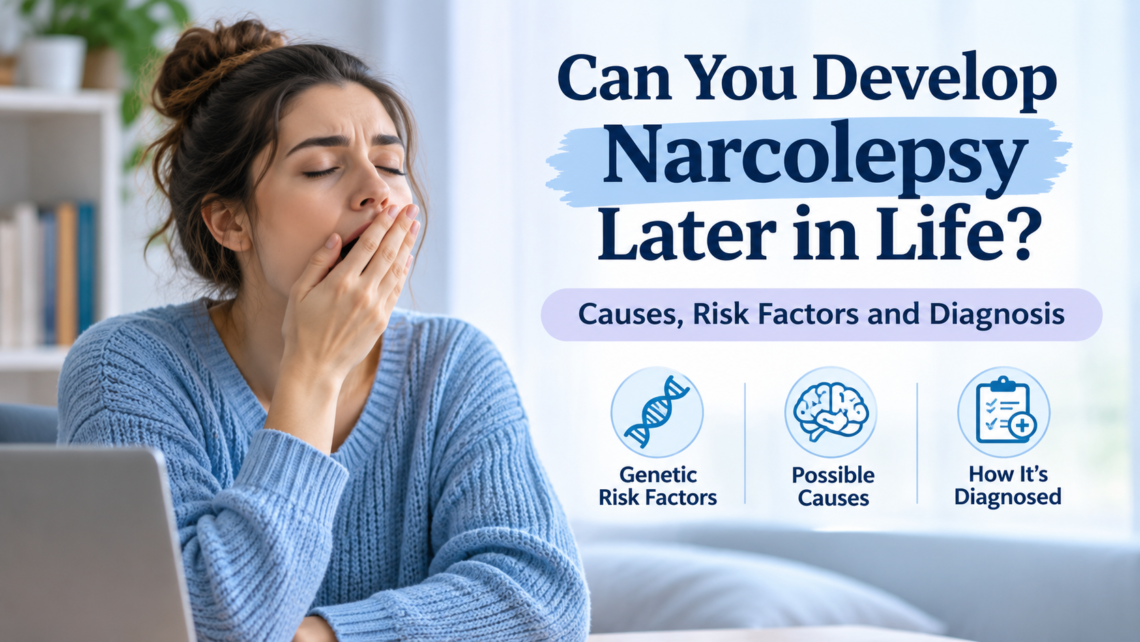
Can You Develop Narcolepsy Later in Life?
Yes. Adults can develop narcolepsy even if they did not experience noticeable symptoms during childhood. The condition affects the brain’s sleep-wake cycle and can cause excessive daytime sleepiness, disrupted nighttime sleep, and other symptoms.
According to the National Institute of Neurological Disorders and Stroke (NINDS), symptoms usually begin between the ages of 7 and 25, but they can start at any age.
Because symptoms may be mild or go unrecognized for years, some people are diagnosed in their 30s, 40s, 50s, or later. It is important to distinguish between the age when symptoms first appear and the age when a person receives a diagnosis.
For example, someone may have experienced mild daytime sleepiness for years but only seek medical attention when it begins affecting work, driving, or other daily activities.
Some people also find it difficult to identify exactly when their symptoms began because daytime sleepiness may develop gradually.
Can You Develop Narcolepsy Later in Life Without Having It as a Child?
Yes. A person diagnosed with narcolepsy during adulthood does not necessarily need to have experienced obvious sleep problems during childhood.
Excessive daytime sleepiness may be mistaken for ordinary tiredness, insufficient sleep, stress, or another sleep disorder. This can delay an accurate diagnosis.
In other cases, symptoms may become more noticeable over time and begin interfering with work, driving, and daily responsibilities. Someone who previously managed occasional sleepiness may eventually find it difficult to stay awake during routine activities.
However, daytime sleepiness does not automatically indicate narcolepsy. Insufficient sleep, certain medications, and other medical or sleep-related conditions can cause similar symptoms.
What Causes Narcolepsy?
The exact cause of narcolepsy is not fully understood. Research suggests that the condition may develop through a combination of genetic susceptibility, immune system activity, and environmental factors.
One of the most important findings is the role of a brain chemical called hypocretin, also known as orexin. This chemical helps regulate wakefulness and the sleep-wake cycle.
In many people with narcolepsy type 1, hypocretin levels are extremely low because the neurons responsible for producing it have been lost.
Several factors are thought to contribute to the development of narcolepsy.
1. Low Levels of Hypocretin (Orexin)
Hypocretin is a neurotransmitter produced by neurons in the hypothalamus, a region of the brain involved in regulating sleep, appetite, and other important functions.
It helps maintain wakefulness and regulate transitions between sleep and waking.
In people with narcolepsy type 1, the loss of hypocretin-producing neurons can cause hypocretin levels to become extremely low. This disrupts the brain’s ability to regulate sleep and wakefulness.
Low hypocretin levels are strongly associated with excessive daytime sleepiness and other symptoms of narcolepsy type 1.
However, hypocretin levels are generally normal in people with narcolepsy type 2. This is one of the important differences between the two types of the disorder.
2. Autoimmune Factors
Researchers believe that an abnormal immune response may contribute to the development of narcolepsy type 1.
An autoimmune response occurs when the immune system mistakenly attacks the body’s own healthy cells or tissues.
In narcolepsy type 1, researchers suspect that immune system activity may contribute to the loss of hypocretin-producing neurons. However, the exact process that causes this damage is still being investigated.
Certain infections and environmental exposures have also been studied as possible triggers in people who are genetically susceptible to the condition.
Having an infection or an autoimmune disorder does not necessarily mean that a person will develop narcolepsy.
3. Brain Injury or Damage
In rare cases, narcolepsy-like symptoms can develop following damage to parts of the brain involved in controlling sleep and wakefulness.
This form is known as secondary narcolepsy. It may occur when an injury, tumor, or another neurological condition affects the hypothalamus or nearby brain regions.
Secondary narcolepsy is uncommon and may occur alongside other neurological symptoms, depending on the location and extent of the brain damage.
Is Narcolepsy Genetic or Hereditary?
Narcolepsy has a genetic component, but it is not usually inherited in a straightforward way from parents to children.
One of the genetic variations most strongly associated with narcolepsy is HLA-DQB1*06:02, which is involved in immune system function. This variation is particularly associated with narcolepsy type 1, especially in people who also have cataplexy and low hypocretin levels.
However, having this genetic variation does not mean that a person will definitely develop narcolepsy. The variation is also found in people who do not have the condition.
Most cases occur in people without a known family history. Although narcolepsy can sometimes affect more than one family member, it does not follow a simple inheritance pattern.
According to MedlinePlus Genetics, narcolepsy likely results from a combination of genetic and environmental factors rather than a single gene being passed directly from parent to child.
Is Narcolepsy Hereditary From Parents?
Narcolepsy is not usually inherited directly from a parent in the way that some single-gene disorders are.
Having a close family member with narcolepsy may increase a person’s risk, but it does not mean they will develop the condition.
Genetic testing is not routinely used on its own to diagnose narcolepsy because the associated genetic variations do not reliably predict who will develop the disorder.
At What Age Can Narcolepsy Develop?
Narcolepsy can develop at almost any age, although symptoms most commonly begin during childhood, adolescence, or young adulthood.
Research has identified two periods when symptoms may commonly emerge:
- Early adolescence: Some individuals begin experiencing excessive daytime sleepiness and other symptoms during their school years.
- Young adulthood: Others first notice symptoms during their late teens or early adult years.
However, these are common patterns rather than strict age limits. Symptoms can also become noticeable later in adulthood.
The age at which symptoms begin may differ from the age at which someone receives a diagnosis. Some people experience symptoms for years before a sleep specialist identifies the underlying condition.
What Are the Symptoms of Narcolepsy?
Narcolepsy affects the way the brain controls sleep and wakefulness. Symptoms can vary between individuals, and not everyone experiences all of them.
The most common symptoms include:
Excessive Daytime Sleepiness
Excessive daytime sleepiness is one of the main symptoms of narcolepsy. A person may experience an overwhelming need to sleep during the day, even after getting what seems like sufficient sleep at night.
They may struggle to stay awake while working, studying, reading, or having conversations. Some people experience sudden sleep episodes during everyday activities.
Cataplexy
Cataplexy is a sudden loss of muscle tone that may occur in response to strong emotions such as laughter, excitement, surprise, or anger.
It can cause mild symptoms, such as drooping eyelids or weakness in the face, or more noticeable episodes involving the knees, arms, or entire body.
Cataplexy is associated with narcolepsy type 1 but is not usually present in narcolepsy type 2.
Sleep Paralysis
Sleep paralysis occurs when a person temporarily cannot move or speak while falling asleep or waking up.
Although the experience can feel frightening, it usually lasts a short time. It happens when the normal muscle paralysis associated with REM sleep continues into the transition between sleep and wakefulness.
Sleep-Related Hallucinations
Some people experience vivid visual, auditory, or other sensory experiences while falling asleep or waking up. These are known as sleep-related hallucinations.
They may feel realistic and can sometimes be confusing or distressing.
Disrupted Nighttime Sleep
Although people with narcolepsy may feel extremely sleepy during the day, they can also have difficulty staying asleep at night.
They may wake up repeatedly, experience vivid dreams, or have fragmented nighttime sleep. As a result, they may feel tired even after spending several hours in bed.
How Is Narcolepsy Diagnosed?
Narcolepsy is diagnosed through a medical evaluation, a review of symptoms and sleep history, and specialized sleep tests.
Because excessive daytime sleepiness can occur with several other conditions, a healthcare professional must consider alternative explanations before confirming a diagnosis.
A sleep medicine specialist or neurologist may be involved in the evaluation.
1. Medical History and Sleep Evaluation
The doctor will ask about daytime sleepiness, nighttime sleep patterns, sudden sleep episodes, and other symptoms.
They may also ask whether the person experiences muscle weakness triggered by emotions, sleep paralysis, or vivid experiences while falling asleep or waking up.
A sleep diary may be recommended to record bedtime, waking time, daytime naps, and episodes of sleepiness over approximately one to two weeks.
This information helps the specialist understand the person’s sleep patterns and identify possible contributing factors.
2. Overnight Sleep Study (Polysomnography)
An overnight sleep study, also called polysomnography (PSG), records different body functions while a person sleeps.
These may include:
- Brain activity.
- Eye movements.
- Muscle activity.
- Breathing patterns.
- Heart rate.
- Blood oxygen levels.
The test helps doctors evaluate sleep patterns and identify other conditions, such as obstructive sleep apnea, that may cause excessive daytime sleepiness.
3. Multiple Sleep Latency Test (MSLT)
The Multiple Sleep Latency Test (MSLT) is commonly performed the day after an overnight sleep study.
It measures how quickly a person falls asleep during scheduled daytime nap opportunities and whether they enter rapid eye movement (REM) sleep unusually quickly.
People with narcolepsy may fall asleep faster than expected and enter REM sleep during these naps.
The results are interpreted alongside the person’s symptoms, sleep history, and overnight sleep study. The MSLT should not be interpreted in isolation because insufficient sleep, untreated sleep disorders, medications, and other factors can affect the results.
4. Hypocretin Testing
In certain cases, a doctor may recommend measuring hypocretin levels in the cerebrospinal fluid (CSF), which surrounds the brain and spinal cord.
This requires a lumbar puncture, also known as a spinal tap.
Very low hypocretin levels can support a diagnosis of narcolepsy type 1. However, this test is not necessary for every person being evaluated.
The NINDS information on narcolepsy provides further details about the diagnostic process and specialized sleep tests.
What Kind of Doctor Treats Narcolepsy?
A sleep medicine specialist is generally the most appropriate healthcare professional for evaluating and managing suspected narcolepsy.
Depending on the person’s symptoms and medical history, a neurologist may also be involved.
A primary care physician can be a useful starting point. They can review symptoms, assess possible causes of daytime sleepiness, and refer the person to a sleep specialist when needed.
Other healthcare professionals may contribute to care when additional medical conditions are present.
When Should You See a Doctor?
Occasional tiredness is common and does not necessarily indicate narcolepsy. However, persistent daytime sleepiness or repeated episodes of falling asleep unexpectedly deserve medical attention.
Consider arranging an evaluation if you:
- Frequently struggle to stay awake during the day despite getting sufficient nighttime sleep.
- Experience sudden and uncontrollable sleep episodes.
- Have episodes of muscle weakness triggered by strong emotions.
- Experience repeated sleep paralysis or vivid hallucinations around sleep.
- Find that daytime sleepiness is interfering with work, education, driving, or daily activities.
If you feel sleepy while driving, stop driving as soon as it is safe to do so. Avoid driving until you can remain alert and have discussed the problem with a healthcare professional.
A doctor can help determine whether your symptoms are related to narcolepsy, another sleep disorder, medication effects, or a different medical condition.
Final Thoughts
Yes, you can develop narcolepsy later in life, even if you did not experience noticeable symptoms during childhood. Although the condition commonly begins during adolescence or young adulthood, symptoms can emerge at different ages, and diagnosis may be delayed for years.
The exact causes of narcolepsy are not completely understood. Research points to a combination of genetic susceptibility, immune system activity, and, in rare cases, damage to specific brain regions involved in regulating sleep.
If persistent daytime sleepiness, sudden sleep episodes, or other symptoms are affecting your daily life, consult a healthcare professional. A proper evaluation, including specialized sleep testing when appropriate, can help determine whether narcolepsy or another condition is responsible.
Medical Disclaimer: This article is for informational and educational purposes only. It is not a substitute for professional medical advice, diagnosis, or treatment. Persistent daytime sleepiness and other sleep-related symptoms can have several causes. Consult a qualified healthcare professional or sleep medicine specialist for an appropriate evaluation. Do not ignore medical advice or delay seeking care because of information in this article.